
One of the fundamental beliefs in Islam is faith in the divine books revealed by Allah. Muslims believe that Allah sent guidance to humanity through His chosen prophets and messengers. These revelations were preserved in sacred scriptures known as the Holy Books of Islam.
Many people search for terms such as 4 Holy Books of Islam, 4 Books of Allah, Islamic Holy Books, Holy Books of Islam and Their Prophets, and Books Revealed by Allah. Understanding these divine scriptures helps Muslims strengthen their faith and appreciate Allah’s guidance throughout history.
In this comprehensive guide, we will explore the four holy books in Islam, the prophets who received them, and their significance in Islamic teachings.
What Are the Holy Books of Islam?
The Holy Books of Islam are divine scriptures revealed by Allah to guide mankind toward righteousness, worship, and moral conduct. These sacred books contained Allah’s commands, teachings, and laws for different nations and periods.
Muslims believe that Allah revealed several scriptures, but the four major books specifically mentioned and recognized in Islamic teachings are:
- Tawrat (Torah)
- Zabur (Psalms)
- Injil (Gospel)
- Quran
These are commonly known as the 4 Holy Books of Islam or the 4 Books of Allah.
Belief in Holy Books in Islam
Belief in Allah’s revealed books is one of the six pillars of Iman (faith). Every Muslim must believe that Allah sent divine scriptures to guide humanity.
Allah says in the Quran:
“The Messenger has believed in what was revealed to him from his Lord, and so have the believers.” (Quran 2:285)
This belief includes:
- Accepting that Allah revealed divine books.
- Respecting all original revelations.
- Believing the Quran is the final and preserved scripture.
- Recognizing that previous scriptures were revealed to earlier prophets.
The 4 Holy Books of Islam and Their Prophets
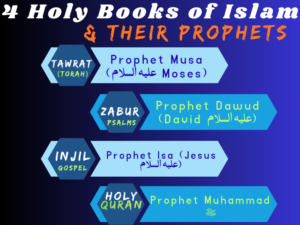
1. Tawrat (Torah)
Prophet:
Prophet Musa (Moses عليه السلام)
The Tawrat was revealed to Prophet Musa (AS) as guidance for the Children of Israel. It contained commandments, laws, and teachings intended for his people.
The Torah is one of the most important books revealed by Allah. Muslims believe the original Tawrat was a divine revelation, although parts of it were altered over time.
Main Teachings of the Tawrat
- Worship of Allah alone
- Moral and ethical laws
- Guidance for the Children of Israel
- Divine commandments
2. Zabur (Psalms)
Prophet:
Prophet Dawud (David عليه السلام)
The Zabur was revealed to Prophet Dawud (AS). Unlike the Tawrat, it focused more on praises of Allah, supplications, wisdom, and spiritual guidance.
The Zabur is often associated with the Psalms known today, although Muslims believe the original revelation was from Allah.
Main Teachings of the Zabur
- Glorification of Allah
- Spiritual reflection
- Wisdom and guidance
- Remembrance of Allah
3. Injil (Gospel)
Prophet:
Prophet Isa (Jesus عليه السلام)
The Injil was revealed to Prophet Isa (AS). It brought guidance, mercy, and confirmation of previous revelations.
Muslims believe the original Injil was a divine book revealed by Allah. However, the current versions of the Gospel are not considered identical to the original revelation.
Main Teachings of the Injil
- Worship of Allah
- Compassion and mercy
- Spiritual purification
- Guidance for the Children of Israel
4. Holy Quran
Prophet:
Prophet Muhammad ﷺ
The Quran is the final and greatest revelation sent by Allah to the Prophet Muhammad ﷺ through Angel Jibreel (Gabriel).
Unlike previous scriptures, the Quran remains completely preserved in its original Arabic language. It serves as guidance for all humanity until the Day of Judgment.
Main Teachings of the Quran
- Tawheed (Oneness of Allah)
- Worship and obedience
- Moral conduct
- Social justice
- Family values
- Preparation for the Hereafter
Allah says:
“Indeed, it is We who sent down the Quran and indeed, We will be its guardian.” (Quran 15:9)
Table of the 4 Holy Books of Islam and Their Prophets
| Holy Book | Prophet | Purpose |
|---|---|---|
| Tawrat (Torah) | Musa (AS) | Guidance and laws |
| Zabur (Psalms) | Dawud (AS) | Praise and wisdom |
| Injil (Gospel) | Isa (AS) | Mercy and guidance |
| Quran | Muhammad ﷺ | Final guidance for humanity |
Are There 4 or 5 Holy Books in Islam?
Many people search for the 5 Holy Books of Islam, also known as the 5 Books of Allah.
The four major books are Tawrat, Zabur, Injil, and Quran. However, Islamic sources also mention smaller revelations known as Suhuf (Scrolls).
These include:
- Scrolls of Ibrahim (Abraham عليه السلام)
- Scrolls of Musa (Moses عليه السلام)
Because of these scrolls, some people refer to five or more divine scriptures. However, the four major revealed books remain the most widely recognized holy books in Islam.
Why Is the Quran the Final Holy Book?
The Quran is unique among all divine scriptures because:
- It is preserved without alteration.
- It confirms previous revelations.
- It is meant for all people and all times.
- It completes Allah’s message to humanity.
Muslims believe no new holy book will be revealed after the Quran.
Importance of Learning About the Holy Books of Islam
Studying the Islamic holy scriptures helps Muslims:
- Strengthen their faith.
- Understand Allah’s guidance.
- Learn the history of prophets.
- Appreciate the message of the Quran.
- Develop respect for divine revelation.
Knowledge of the holy books and prophets is an important part of Islamic education for children and adults alike.
Conclusion
The 4 Holy Books of Islam—the Tawrat, Zabur, Injil, and Quran—were revealed by Allah to His chosen prophets as guidance for humanity. These sacred scriptures form an essential part of Islamic belief and demonstrate Allah’s mercy in providing direction to mankind throughout history.
Muslims are required to believe in all books revealed by Allah while recognizing that the Holy Quran is the final, complete, and perfectly preserved revelation. Understanding the 4 Books of Allah and their prophets helps strengthen faith and deepen appreciation for the message of Islam.
By learning about the Holy Books of Islam, believers gain valuable insight into the divine guidance that has shaped humanity from the time of Prophet Adam (AS) to Prophet Muhammad ﷺ.