
Muslims need to make sure that what they buy is considered halal. Many modern food items’ additives are listed with E-numbers that may confuse things. Some E-codes come from natural sources such as plants, and some are synthetic and are still considered halal. Depending on their preparation method, some animals can be haram or open to question when used as food. This article highlights a list of halal E-numbers, helping you to choose and eat safely, InshaAllah.
📌 What Are E-Numbers?
E-numbers refer to substances used as food additives and permitted by the European Union and many other regions. They consist of preservatives, colourings, enhancements for taste, emulsifiers, and stabilisers. Although these codes are difficult for most people, understanding them matters, especially when someone follows the halal law.
🕌 Why Muslims Should Care About E-Codes
A major part of being Muslim is to follow the halal way of eating and stay away from haram or doubtful foods. While plants and some animals are halal, E-numbers may come from sources that are not halal for Muslims. As a result, it is very important to understand which E-numbers are safe.
✅ Halal E-Numbers: Detailed Breakdown
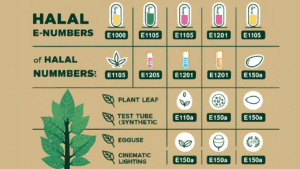
The E-code list below comprises items generally recognized as halal by scholars and those in the food industry. They are prepared in a halal way and are allowed for Muslims to eat.
E100 – Curcumin
Source: Plant-based (Turmeric)
Function: Natural yellow colouring
Halal Status: ✅ Halal
Comment: Extracted from turmeric, a natural spice with many health benefits.
E1105 – Lysozyme
Source: Egg white (from halal chickens)
Function: Preservative
Halal Status: ✅ Halal
Comment: Derived from chicken eggs. Considered halal as long as eggs are from halal sources.
E1201 – Polyvinylpyrrolidone (PVP)
Source: Synthetic
Function: Stabiliser
Halal Status: ✅ Halal
Comment: Chemically manufactured; contains no animal ingredients.
E1202 – Polyvinylpolypyrrolidone (PVPP)
Source: Synthetic
Function: Clarifying agent
Halal Status: ✅ Halal
Comment: Often used in beverages; completely synthetic.
E131 – Patent Blue V
Source: Synthetic
Function: Blue colour
Halal Status: ✅ Halal
Comment: Laboratory-produced colouring; no animal involvement.
E1404 – Oxidized Starch
Source: Plant-based (like corn, potatoes)
Function: Thickener
Halal Status: ✅ Halal
Comment: Derived from halal plants and processed safely.
E1410 – Monostarch Phosphate
Source: Plant-based
Function: Stabilizer
Halal Status: ✅ Halal
E1412 – Distarch Phosphate
Source: Plant-based
Function: Thickener
Halal Status: ✅ Halal
E1413 – Phosphated Distarch Glycerol
Source: Plant-based
Function: Stabilizer
Halal Status: ✅ Halal
E1414 – Acetylated Distarch Phosphate
Source: Plant-based
Function: Emulsifier
Halal Status: ✅ Halal
E1420 – Acetylated Starch
Source: Plant-based
Function: Stabilizer
Halal Status: ✅ Halal
E1422 – Acetylated Distarch Adipate
Source: Plant-based
Function: Emulsifier
Halal Status: ✅ Halal
E1440 – Hydroxypropyl Starch
Source: Plant-based
Function: Thickener
Halal Status: ✅ Halal
E1442 – Hydroxypropyl Distarch Phosphate
Source: Plant-based
Function: Stabilizer
Halal Status: ✅ Halal
E1450 – Starch Sodium Octenyl Succinate
Source: Plant-based
Function: Emulsifier
Halal Status: ✅ Halal
E1505 – Triethyl Citrate
Source: Synthetic or from citrus fruits
Function: Carrier for flavors
Halal Status: ✅ Halal
Comment: Used in flavorings and capsules; safe for consumption.
E150a – Plain Caramel
Source: Sugar-based
Function: Brown coloring
Halal Status: ✅ Halal
Comment: Made by heating sugar; free from alcohol or animal products.
E150b – Caustic Sulfite Caramel
Source: Sugar-based
Function: Coloring
Halal Status: ✅ Halal
Comment: Produced using sulfite compounds; not from animals.
E150c – Ammonia Caramel
Source: Sugar + ammonia
Function: Coloring
Halal Status: ✅ Halal
Comment: Mostly found in cola drinks; halal unless alcohol is used in processing (rare).
E150d – Sulfite Ammonia Caramel
Source: Sugar + ammonia + sulfite
Function: Colouring
Halal Status: ✅ Halal
Comment: Most commonly used caramel colouring; halal-certified in most cases.
📋 Halal Consumer Checklist for E-Numbers
Before purchasing a product, keep this simple checklist in mind:
✅ Does the product have known halal E-numbers (like above)?
❌ Are there any animal-based E-numbers that are not specified as halal?
📦 Is the product halal certified by a recognised body?
📱 Have you researched or scanned the product through trusted apps?
🧠 Have you used your best judgment when in doubt?
📚 Islamic Perspective: Eat Halal, Stay Pure
Islam emphasizes the importance of consuming lawful (halal) and pure (tayyib) food:
“يَا أَيُّهَا النَّاسُ كُلُوا مِمَّا فِي الْأَرْضِ حَلَالًا طَيِّبًا”
“O mankind, eat from whatever is on earth [that is] lawful and pure…”
— Surah Al-Baqarah, 2:168
By knowing which E-codes are halal, we fulfil this command with more awareness.
✅ Summary Table of Halal E-Codes
| E-Code | Name | Halal Status | Source |
|---|---|---|---|
| E100 | Curcumin | ✅ Halal | Plant-based |
| E1105 | Lysozyme | ✅ Halal | Egg (Halal) |
| E1201 | PVP | ✅ Halal | Synthetic |
| E1202 | PVPP | ✅ Halal | Synthetic |
| E131 | Patent Blue V | ✅ Halal | Synthetic |
| E1404 – E1450 | Modified Starches | ✅ Halal | Plant-based |
| E1505 | Triethyl Citrate | ✅ Halal | Citrus/Synthetic |
| E150a – E150d | Caramel Colors | ✅ Halal | Sugar-based |
Bonus Tips for Smart Halal Shopping
- Read Labels Carefully: Always make sure to read the list of ingredients and check the E-code numbers.
- Educate Your Family: Explain E-numbers to people who buy snacks, especially teenagers and kids.
- Be Aware of Regional Differences: An E-number may be made from different parts of the world.
- Support Halal-Friendly Brands: Support businesses that openly work towards ensuring they follow halal standards.
📣 Final Thoughts
Being a Muslim means learning to be aware of the foods and drinks we choose to consume, as well as our actions and words.
فَكُلُوا مِمَّا رَزَقَكُمُ اللَّهُ حَلَالًا طَيِّبا
Therefore, enjoy food that Allah has made allowed and good for you.”
With food coming from complicated and worldwide sources, we need to know what we eat. This guide to halal E-numbers helps you choose wisely regarding your faith.
❓ Frequently Asked Questions (FAQs)
What are E-numbers, and why are they used in food?
E-numbers are assigned to food additives that have been approved for use in the European Union and other regions. They make it possible for products to last longer, have a better texture, an attractive color, and taste better. Some examples are colorings, preservatives, and stabilizers.
Are all E-numbers haram (forbidden) in Islam?
It is not true that all E-numbers are prohibited in Islam. A lot are either plants or synthetically produced and are completely halal. However, some sources of dyes may be from animals, so you should always check where they are made. If you find yourself unsure, check for halal certification or ask experts.
Can synthetic additives be considered halal?
Yes. Generally, an E-number created without haram substances is considered halal. Most colorings and stabilizers that are added to food are considered synthetic.
What should I do if I can’t verify whether an E-number is halal?
Should verification fail, you should not use the product. The Prophet Muhammad ﷺ said: Leave the things that lead you into doubt for the things that cause no doubt. (Tirmidhi) Being picky about your food sources is always safer for your health.
Is it enough to rely on a ‘halal’ label on the packaging?
Having a halal label is good, but sometimes it is not enough. Not all halal products are labeled the same, making them halal in one place and not another. Always check if a halal body certifies the food, and still read the ingredient list, especially for additives and E-codes.