
Introduction
All Muslims parents aspire to see their child being linked with the Holy Quran at an early age. The most frequently asked is:
What is the best age to start learning Quran for children?
The fact is that children all have their own set age. But it is agreed among child development experts and Islamic teachers that the best time to start learning Quran is during childhood.
The proper timing for learning Quran has proved to help children with their pronunciation, reinforcement of memory, instilling Islamic values and their love affair with the Quran.
In this guide, we will talk about the best age to learn the Quran, the age wise breakdown, advantages of learning, indications of an age-appropriate child to learn the Quran and some tips for parents to help their child be successful.
Why Early Quran Learning Is Important
Early Quran education facilitates a child’s spiritual and mental development in a great way.
Early Quran learning with children leads them to:
- Develop a strong love for Islam
- Learn Arabic pronunciation more naturally
- Build strong memory and focus skills
- Grow up with Islamic manners and values
- Establish a lifelong habit of Quran recitation
- Gain confidence in reading and memorization
When children are exposed to the Quran first, they will grow up accepting it as a way of life, instead of just learning about it later.
When is the Best Age for Children to Learn Quran?
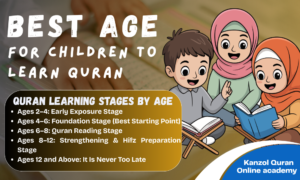
The most recommended age to begin structured Quran learning is:
👉 Between 4 to 7 years old
At this stage, children are mentally ready to:
- Recognize letters and sounds
- Follow simple instructions
- Memorize quickly
- Develop learning habits
- Show curiosity toward stories and learning
However, Quran exposure can begin even earlier through listening, storytelling, and simple Islamic activities.
Quran Learning Stages by Age
Understanding age-wise learning stages helps parents set realistic expectations and avoid pressure.
Ages 2–4: Early Exposure Stage
At this age, formal learning is not required. Instead, focus on natural exposure.
What children can do:
- Listen to Quran recitation daily
- Learn simple words like Allah and Bismillah
- Hear Islamic stories
- Observe parents praying
- Learn short duas
Goal: Build familiarity and love for the Quran.
Ages 4–6: Foundation Stage (Best Starting Point)
This is one of the most important stages for Quran learning.
Children can start:
- Noorani Qaida
- Arabic alphabet recognition
- Basic pronunciation practice
- Short Surahs memorization
- Simple daily Islamic routine
Why this age is ideal:
- High memory absorption
- Natural curiosity
- Easy habit formation
- Strong imitation skills
This stage builds the foundation for future Quran reading and Tajweed.
Ages 6–8: Quran Reading Stage
At this stage, children begin reading the Quran more confidently.
Focus areas:
- Fluent Quran reading
- Basic Tajweed rules
- Improving pronunciation
- Memorizing short Surahs
- Building reading consistency
This is the stage where children transition from learning letters to reading full verses.
Ages 8–12: Strengthening & Hifz Preparation Stage
This is considered one of the best ages for Quran memorization (Hifz).
Children can learn:
- Advanced Tajweed
- Quran memorization
- Understanding meanings
- Regular revision habits
Why this stage is powerful:
- Strong memory retention
- Better discipline
- Improved focus
- Faster learning speed
Ages 12 and Above: It Is Never Too Late
Many parents worry if they missed the “right age,” but Quran learning has no age limit.
Teenagers can still learn effectively because they have:
- Better understanding
- Higher discipline
- Strong reasoning ability
- Clear motivation
With the right teacher and consistency, excellent Quran progress is always possible.
Signs Your Child Is Ready for Quran Learning
Instead of focusing only on age, parents should look for readiness signs:
- Can sit and focus for a few minutes
- Shows interest in books or stories
- Can follow simple instructions
- Repeats words or sounds easily
- Enjoys listening to Quran recitation
- Shows curiosity about Islam
Readiness is more important than age alone.
Benefits of Starting Quran Learning Early
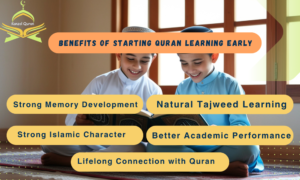
1. Strong Memory Development
Children absorb information faster in early years.
2. Natural Tajweed Learning
Pronunciation becomes easier when learned young.
3. Strong Islamic Character
Children grow up with honesty, kindness, and discipline.
4. Better Academic Performance
Quran learning improves focus and cognitive skills.
5. Lifelong Connection with Quran
Early learners maintain a stronger relationship with Islam.
Common Mistakes Parents Should Avoid
- Forcing children to learn too fast
- Comparing with other children
- Ignoring Tajweed basics
- Irregular learning schedule
- Focusing only on memorization
- Using pressure instead of encouragement
A positive environment is more effective than strictness.
How Parents Can Help Their Child Learn Quran
Parents play the most important role in Quran education.
✔ Create a Daily Routine
Even 15–20 minutes daily is effective.
✔ Be a Role Model
Children copy parents more than instructions.
✔ Encourage, Don’t Pressure
Positive motivation builds confidence.
✔ Make Learning Fun
Use stories, repetition, and rewards.
✔ Make Dua
Pray for your child’s success in learning Quran.
Online Quran Classes for Kids vs Traditional Learning
In the modern world, there are numerous parents who choose online Quran classes for kids for versatility and quality teaching.
Benefits of Online Quran Learning:
- One-on-one attention
- Flexible timing
- Qualified Quran teachers
- Safe home environment
- Structured learning plans
Online Quran learning is especially helpful for busy families.
Quran Learning Stages by Age (SEO Optimized Table)
| Age Group | Quran Learning Stage | What Child Learns | Main Goal |
| 2–4 Years | Early Exposure Stage | Listening to Quran, short duas, Islamic words, stories of Prophets | Build love and familiarity with Quran |
| 4–6 Years | Foundation Stage | Noorani Qaida, Arabic letters, basic pronunciation, short Surahs | Strong base for Quran reading |
| 6–8 Years | Reading Stage | Quran reading, basic Tajweed, fluency practice, memorization of small Surahs | Improve reading confidence |
| 8–12 Years | Strengthening / Hifz Stage | Advanced Tajweed, Quran memorization, understanding meanings | Develop memorization and discipline |
| 12+ Years | Late Learning Stage | Structured Quran learning, Tajweed correction, Hifz or revision | Build consistency and deeper understanding |
Why Choose Kanzol Quran for Kids’ Quran Learning
Kanzol Quran provides a structured and child-friendly learning system designed for modern students.
Features:
- Experienced male & female Quran teachers
- Noorani Qaida for beginners
- Quran reading with Tajweed
- Hifz programs for kids
- Islamic studies lessons
- One-on-one online classes
- Free trial classes
The aim of this is to make the learning of Quran easy, interesting and effective for all the children.
Conclusion
The ideal age to begin learning Quran for kids is not a mere figure, but one that involves readiness, surroundings, and consistency.
While ages 4–7 are ideal for starting structured learning, children of any age can begin their Quran journey with proper guidance.
The primary consideration is providing a positive, motivating and regular teaching environment, leading children to love the Holy Quran.
Frequently Asked Questions (FAQs)
The ideal age is 4 to 7 years, but exposure can start earlier.
Use short Surahs, repetition, listening, and simple daily practice.
Most children start between 4–7 years old depending on readiness.
Focus on duas, listening to Quran, and basic Islamic manners.
Usually between 7–12 years, when memory skills are strong.