
Studying the Quran is one of the essential parts of a Muslim’s life, but families nowadays have more than one way of studying. Some students go to a mosque in their locality, and others opt for online Quran classes in their homes.
This raises an important question: online Quran classes vs. traditional madrasa — which option is better?
There are no one-size-fits-all solutions for all students. The decision is subjective and depends on the student’s age, learning objectives, time, teacher, class size, and learning environment. In both approaches, meaningful education of the Quran can be provided if they are well organised.
Online Quran Classes vs Traditional Madrasa: Quick Comparison
| Factor | Online Quran Classes | Traditional Madrasa |
|---|---|---|
| Learning location | From home or anywhere with internet | Physical classroom |
| Class schedule | Usually flexible | Usually fixed |
| Class format | Often one-to-one or small groups | Commonly group-based |
| Teacher attention | More individual attention in one-to-one classes | Shared among students |
| Travel | No travel required | Requires travel |
| Learning environment | Home-based and personalised | Face-to-face and community-based |
| Tajweed correction | Live individual correction | Depends on class size |
| Parent involvement | Easier to monitor from home | Depends on the institution |
| Peer interaction | Limited in one-to-one classes | More opportunities for interaction |
This will differ from one quran academy or madrasa to another and must always be taken into account along with the format; the quality of the teacher and programme should always be a factor.
What is the difference between Online Quran Classes and a traditional Madrasa?
The biggest difference between online Quran classes and traditional madrasa learning is the learning environment and teaching format. Online classes allow students to learn from home through live lessons, while a traditional madrasa provides in-person Quran education in a physical classroom.
- Learning Environment: Online Quran classes take place at home, while traditional madrasa learning happens in a classroom with other students.
- Teacher Interaction: Online classes can offer one-to-one Quran teaching and individual attention. In a madrasa, students usually learn together under the supervision of a teacher.
- Class Schedule: Online Quran learning often provides more flexible timings, whereas traditional madrasas generally follow fixed class schedules.
- Accessibility: Online classes allow students to learn from qualified Quran teachers regardless of their location. A local madrasa is more dependent on the teachers and programs available nearby.
- Social Learning: Traditional madrasas provide face-to-face interaction and a community learning environment, while online classes focus more on personalized teacher-student interaction.
Both approaches can support Quran reading, Tajweed, memorization, and Islamic education. The main difference is whether a student learns best through a physical classroom or a flexible, personalized online environment.
Benefits of Online Quran Classes
Flexibility is one of the top benefits of online Quran learning. Students are able to plan schoolwork around their work, family, and other commitments.
Finally, it will eliminate the need for parents to transport children to and from a madrasa. Adults who have busy schedules may find it easier to maintain regular Quran lessons without travelling.
One-to-One Quran Learning
One-to-one Quran classes can focus completely on the student. This is especially useful for novice users who require frequent corrections and instructions.
Individual feedback on Tajweed, letter articulation, rules of recitation, and sewwro recitation xocnao can be provided to a student learning the Quran with Tajweed.
Online classes may also provide access to teachers who are not in the community.
Flexible Quran Classes for Kids and Adults
Online Quran classes can be suitable for different age groups. Children can learn Noorani Qaida, Quran reading, Tajweed, and memorization, while adults can study at times that fit around their work and family responsibilities.
This flexibility can make it easier to maintain consistency, which is an important part of Quran learning.
What Are the Benefits of Traditional Madrasa Learning?
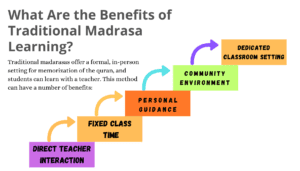
Traditional madarasas offer a formal, in-person setting for memorization of the quran, and students can learn with a teacher. This method can have a number of benefits:
- Direct Teacher Interaction: Students can get instant guidance while practicing Quran reading, pronunciation, and Tajweed.
- Fixed class time: Children have a regular habit of attending Quran lessons as these are regularly scheduled.
- Personal Guidance: Teachers can watch students’ progress, respond to queries, and resolve issues as they occur during the session.
- Community Environment: Learners can learn with other learners, which also provides social interaction and a shared environment for Quran and Islamic education.
- Dedicated Classroom Setting: A special area of learning can assist pupils in maintaining their concentration and engaging in a structured way in their learning of the Quran.
Which Is Better for Children?
For children, the decision should not be based only on whether the class is online or physical.
Parents should consider:
- Does the teacher have experience teaching children?
- Is the class size manageable?
- Does the child receive enough individual attention?
- Can the child maintain concentration during the lesson?
- Is the schedule compatible with school and family life?
- Does the programme teach correct Quran pronunciation and Tajweed?
- Can parents follow the child’s progress?
A small, well-organised traditional class may work very well for one child, while another child may learn better through one-to-one online Quran classes.
The quality of teaching and the child’s ability to learn consistently are more important than the format alone.
What About Adults and Beginners?
Online Quran classes can be especially convenient for adults who want to learn Quran but have limited free time.
Adults who never learned to read the Quran properly can start with Noorani Qaida or basic Quran reading and gradually move toward Tajweed and fluent recitation.
Because lessons can be arranged around work and family commitments, online learning may make it easier for adult beginners to continue their studies regularly.
Online Quran Classes for Tajweed and Hifz
For students whose main goal is improving recitation, online Quran classes with Tajweed can provide direct teacher feedback during live lessons.
Similarly, students working on Quran memorization or Hifz can follow a structured programme with regular recitation, revision, and teacher feedback.
However, the success of either online or traditional Hifz depends heavily on the teacher, the student’s commitment, regular revision, and the structure of the programme.
How to Choose the Right Quran Learning Option
Before enrolling, look beyond the words “online” or “traditional.” Ask about the actual learning experience.
Look for:
- Qualified and experienced teachers
- A clear Quran learning curriculum
- Proper Tajweed and pronunciation correction
- Suitable class size
- A schedule that the student can maintain
- Regular progress assessment
- A safe and respectful learning environment
- Teaching methods appropriate for the student’s age and level
If possible, speak with the teacher or academy before making a decision. A trial lesson can also help you understand whether the teaching style suits the student.
Online Quran Classes vs Local Madrasa: Finding the Right Fit
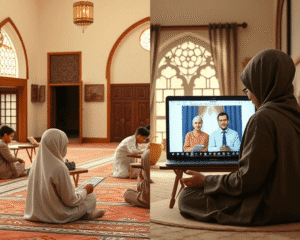
Both local madrasa education and online Quran classes can help students learn the Quran. Kanzol Quran offers a flexible, personalized online learning experience, while a local madrasa offers face-to-face learning and a community environment.
- Local Madrasa: Face-to-face lessons, physical classroom, discipline, and community interaction.
- Kanzol Quran: Live one-to-one Quran classes with individual teacher attention.
- For Kids: Flexible online Quran classes for kids that fit around school and family routines.
- For Adults: Convenient Quran classes online without travelling to a local madrasa.
- For Tajweed & Hifz: Focused lessons for the Quran with Tajweed, Quran reading, and memorization.
- For Parents: Parents can stay involved and monitor their child’s online Quran learning from home.
Kanzol Quran is not a replacement for the importance of a local madrasa; it is an alternative for students who require flexibility, personal attention, and convenient online Quran education.
Frequently Asked Questions
Are online Quran classes as effective as traditional madrasa classes?
They can be effective when the programme has qualified teachers, suitable class sizes, live correction, and a structured learning plan. The quality of teaching matters more than the location of the lesson.
Are online Quran classes good for children?
Yes. Online Quran classes can work well for children when lessons are age-appropriate, interactive, and supported by parents when necessary.
Can I learn the Quran with Tajweed online?
Yes. A qualified online Quran teacher can teach Tajweed and provide live correction during Quran recitation.
Are online Quran classes suitable for adults?
Yes. Adults can learn the Quran online from the beginner level, including Noorani Qaida, Quran reading, Tajweed, and memorization.
Is a traditional madrasa better for Quran learning?
A traditional madrasa may be a good choice for students who benefit from face-to-face interaction, fixed routines, and a community learning environment. The right option depends on the student’s needs and the quality of the available programme.