
Introduction
The crescent moon and star are a sign and symbol of Islam for many people around the world. It is featured in the flags of some Muslim nations, on mosque domes, and in Islamic art. So, an essential question remains:
Is the Crescent Moon the Official Muslim Symbol?
The answer may surprise many readers.
Islam has no official religious symbol as established by Allah and taught by Prophet Muhammad (saw), unlike other religions. Islam, however, advocates the belief in one God (Allah), worship, righteousness, and obedience to the Quran and Sunnah, rather than religious icons or symbols.
In this complete guide, you’ll learn:
- Does Islam have an official symbol?
- Why is the crescent moon linked to Islam?
- What does the Quran say about symbols?
- The history of the crescent and star
- Common Islamic symbols and their meanings
- Misconceptions about Islamic symbols
At the end of this article, you will have a very clear idea of what Islam is and what it’s not, as authentic Islam tells you.
What Is the Symbol of Islam?
One of the most frequented searches online is:
“What is the symbol of Islam?”
While the crescent moon and star are often the first thing that springs to mind, Islam officially does not designate a religious symbol.
Instead, the true foundation of Islam is built upon:
- Belief in Allah alone
- The Holy Quran
- The Sunnah of Prophet Muhammad ﷺ
- The Five Pillars of Islam
- Faith (Iman)
These principles define a Muslim’s identity—not a visual emblem.
Does Islam Have an Official Symbol?
The simple answer is:
No.
The Quran and authentic Hadith do not make any designation of any object, image,e or emblem as the official symbol of Islam.
Throughout the life of Prophet Muhammad ﷺ:
- No Islamic flag displayed a crescent moon.
- Mosques were not decorated with religious icons.
- Muslims did not worship or venerate symbols.
Rather, Islam shifted its attention to the worship of Allah alone and not to the sacredness of physical images.
Allah says:
“Indeed, this religion of yours is one religion, and I am your Lord, so worship Me.”
(Quran 21:92)
This verse highlights that faith—not symbols—is what unites Muslims.
Why Is the Crescent Moon Associated with Islam?
This is perhaps the biggest misconception.
The crescent moon became associated with Islam centuries after the time of Prophet Muhammad (saws).
The symbol’s popularity is believed to have increased during the Ottoman Empire when it was used on the flags and buildings of the empire. Many Muslim-dominated countries continued to employ this emblem, and people worldwide came to identify it with Islam.
One must be aware that this is an historical-cultural association, not a religious order.
The History of the Crescent and Star
The crescent moon phase of the crescent was also present before the advent of Islam.
The crescent was adopted by art, coins, and flags of ancient civilizations, such as the Greeks, Romans, Persians, and the Byzantines.
The crescent was closely linked to the rule of Muslim political authorities rather than Islamic beliefs as the Ottoman Empire expanded.
This is why many people think that the crescent is a symbol of Islam.
Is the Crescent Moon Mentioned in the Quran?
Yes—but not as a religious emblem.
Allah says:
“They ask you about the new moons. Say, they are measurements of time for the people and for Hajj.”
(Quran 2:189)
Here, the moon is mentioned as a way to determine:
- Islamic months
- Ramadan
- Hajj
- Eid
- Other acts of worship
The Quran never instructs Muslims to adopt the moon as a religious symbol.
Islamic View on Religious Symbols
Islam encourages believers to focus on:
- Faith
- Worship
- Good character
- Knowledge
- Obedience to Allah
The teaching of Islam does not use symbols; instead, it teaches that the actions and beliefs of the Muslim are the true manifestation of their religion.
Prophet Muhammad sallallahu alaihi wassallam gave Muslims instructions on avoiding any actions that might lead to superstition or make objects sacred for which there is no proof.
Common Symbols Commonly Associated with Islam
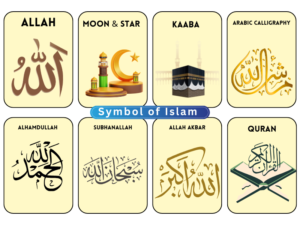
1. Crescent Moon and Star
Meaning: Cultural and historical representation.
Official? No.
2. The Kaaba
The Kaaba is the direction (Qiblah) toward which Muslims pray.
It is the holiest site in Islam, but it is not considered the official symbol of Islam.
3. Arabic Calligraphy
Beautiful Quranic verses written in Arabic are often used in Islamic art.
Calligraphy reflects the importance of the Quran rather than functioning as a sacred symbol.
4. The Shahada
The declaration:
La ilaha illallah, Muhammadur Rasulullah
Is the foundation of Islamic belief.
It is usually used in Islamic art and on a few flags, but it is not a symbol; it is a declaration of faith.
5. The Quran
The Quran is the word of Allah and the main source of guidance for Muslims.
Muslims revere the Quran, but it is not a religious symbol.
Table: Common Symbols Associated with Islam
| Symbol | Religious Status | Meaning |
|---|---|---|
| Crescent Moon | Cultural | Islamic calendar and historical association |
| Star | Cultural | Often paired with the crescent |
| Kaaba | Sacred Site | Direction of prayer (Qiblah) |
| Quran | Holy Book | Divine guidance |
| Shahada | Statement of Faith | Core belief of Islam |
| Arabic Calligraphy | Artistic Tradition | Beauty of Quranic verses |
What Truly Represents Islam?
Instead of symbols, Islam is represented by its teachings:
- Tawheed (Oneness of Allah)
- Prayer (Salah)
- Charity (Zakah)
- Fasting (Sawm)
- Pilgrimage (Hajj)
- Mercy
- Justice
- Honesty
- Compassion
- Good character
These values are what make the religion, more so than any emblem of sight.
Common Misconceptions About the Symbol of Islam
Myth: Islam officially uses the crescent moon.
Fact: There is no Quranic or Hadith evidence establishing it as Islam’s official symbol.
Myth: Muslims worship the moon.
Fact: Muslims worship Allah alone.
Myth: Every mosque must display a crescent.
Fact: Many mosques have no crescent at all.
Myth: The crescent appeared during Prophet Muhammad’s lifetime.
Fact: Its widespread association developed centuries later.
Frequently Asked Questions
What is the official symbol of Islam?
Islam has no official religious symbol prescribed by the Quran or Sunnah. The religion is defined by faith in Allah, the Quran, and the teachings of Prophet Muhammad ﷺ.
Why is the crescent moon linked with Islam?
The crescent became associated with Muslim civilizations through historical use, particularly during the Ottoman Empire, rather than through Islamic scripture.
Does the Quran mention the crescent moon?
Yes. The Quran mentions the moon as a means of measuring time and determining Islamic months, not as a religious emblem.
Is the Kaaba the symbol of Islam?
The Kaaba is the holiest site in Islam and the direction of prayer, but it is not designated as an official symbol.
What best represents Islam?
The best representation of Islam is its belief in one God (Allah), the Quran, the Sunnah, and the practice of the Five Pillars.
Learn Quran and Islamic knowledge at Kanzol Quran.
The first step in learning about Islam is to acquire knowledge of the Quran from the right people. We provide Quran classes for kids, grown-ups, and novices from all over the world on our online Quran platform, Kanzol Quran. Our qualified Quran tutors offer online classes in Quran reading, Tajweed, memorization, and Islamic studies in a flexible setting. From beginners to those deepening their understanding, Kanzol Quran is dedicated to supporting you in your learning journey in a way that is both confident and authentic.
Final Thoughts
Islam has a symbol that many people misunderstand. The Crescent moon and the star have been used in an historical and cultural manner around the world and are not the official religious symbols that have been fixed by the Quran or the Sunnah. The focus of Islam is on the practice of good works, religious devotion, and sincere faith, not on symbols.