The Complete Guide to Quran Stopping Signs: Their Importance and Application
In Quran studies, the proper performance of stopping signs (waqf) is significant for maintaining the correct meanings of the verses. These signs enable the reciter to know where he should avoid pausing, where it has been forbidden to pause, and where he is allowed to pause, with the added benefit of deeper divinity or an invitation to engage in deeper reflection. These signs confused the meaning of the Quran or altered the intended message people get from it.
What Do the Quran’s Stopping Signs Mean?
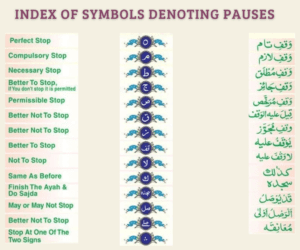
Quran stopping signs refer to signs in the core text of the Quran that alert the person reading the holy book on when to stop or pause. These signs serve many purposes, such as preserving the meaning of the verse, maintaining its grammatical structure, and ensuring smooth reading. Every sign has rules; therefore, the reciter should have accepted and known them.
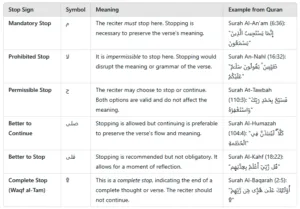
Here’s a breakdown of the most commonly used Quranic stopping signs, their meanings, and examples from the Quran:
Explanation of Each Stop Sign
Mandatory Stop (م):
This symbol means that you, the reader, must halt at this point. If one does not stop, the significance of the conveyed verse may alter, or even the message may be changed entirely. For instance, when reciting Surah Al-An’am, it is preferable to pause after “يَسْمَعُونَ” so that it remains true.
Prohibited Stop (لا):
It is impossible to pause here because it alters the meaning, destroying the grammatical structure of a particular verse. In Surah An-Nahl, failure to continue reading beyond “طَيِّبِينَ” would give an incomplete and incorrect understanding of the verse.
Permissible Stop (ج):
This sign allows the reciter to have flexible timing. There is no need to stop now; the meaning will remain the same, even if the reciter wishes to continue reading. The second option given by Surah At-Tawbah comes after “وَاسْتَغْفِرْهُ.”
Better to Continue (صلى):
Further recitation here can continue; however, it is more appropriate to pause here only if the following lines cannot be recited. Al-Humazah shows that if one goes on to the following line after “كَلَّا,” it does not obscure the verse.
Better to Stop (قلى):
This signification of the sign that there is an improved understanding when one halts here is fascinating. One should not, but it helps the reciter understand the verse and reflect more. For instance, Surah Al-Kahf offers this to ponder at “قُل رَّبِّيٓ,” and then it proceeds.
Complete Stop (Waqf al-Tam ۩):
The word thus indicates that a particular verse or thought has come to a complete end using the complete stop symbol. The recitals should also stop the flow of words and not proceed further because the message is full now. In Surah Al-Baqara,h this is the place where the surah reading stops after the letter هُدًۭى.
Why Quran Stopping Signs Matter?
Until today, some of the rules or stopping signs found in the Quran are not just marks to indicate breaks but also to maintain the ethereal and meaningful rendition of Quranic verses without losing their meanings or their rhythmic incisiveness. Here’s why these signs are so crucial:
Preserving Meaning:
Stopsigns are primarily placed to demonstrate whether the reciter should stop or proceed at a particular place without changing the meaning of the verse. Inappropriate use of the pause cer can lead the recipient to misunderstand the intended message.
Improving Comprehension:
Thus, stopping signs help the reader think through the meaning of the read verse. By using intonation and rhythm, the reciter can better understand the Quran’s message by pausing at the right times.
Maintaining Rhythm:
There is a sort of music in the Quran, a music sent by destiny and accepted by the Prophet. Proper use of stopping signs makes it easier for the recitation to roll on without having to bring out feelings of discomfort or silence to the contents being recited.
A Study of Kanzol Quran Academy for Quran Education
Muslims who want to learn to read and memorize the Quran accurately will benefit from the Kanzol Quran Academy. Being one of the most popular online academies for Quran learning, this academy gives individual lessons regarding writing rules, including the Quranic stopping signs.
The students of Kanzol Quran Academy benefit from learning from male and female Quranic scholars who guide them in interpreting the Holy Quran. The concept used by the academy ensures optimal care, guaranteeing that each student is adequately trained to text correctly, including how to pause believably, without distorting the beauty and integrity of the verses.
It is a virtual academy that provides easy enrollment in its online courses for learners at all levels of reading expertise. If you need to work on your pronunciation and citation skills or have questions about the meaning of the Quran, Kanzol Quran Academy is the place to go.
Focused and productive, Kanzol Quran Academy provides plentiful lessons to help you understand the Quran and apply the stopping signs properly.
Conclusion
Every reciter needs to understand the specific stopping signals, commonly called the Quran, in comprehensible Arabic recitation. By following these signs, a reciter can ensure that they adhere to the correct recitation of the Quran, enhance their understanding of the recitation of the Quran, and also ensure that the flow of the Quranic recitation is achieved.
If you want professional help improving these signs and enhancing your Quran learning, Kanzol Quran Academy offers comprehensive online courses with competent instructors to improve your Quran recitation.
The academy offers programs that help students succeed in studying the Quran, making it appropriate for students who want to strengthen their relationship with the holy Quran.