
Zakat is one of the pillars of Islam and an act of worship that is important for Muslims to perform and to give to those in need. Zakat, if the conditions are met, is a fundamental requirement of their faith for Muslims.
But calculating Zakat may sometimes be confusing. Many people ask questions regarding the assets included, how to calculate the Zakat of cash and savings, whether gold and silver are included in Zakat, and how the Nisab threshold affects it.
We’ve made it easy for you to calculate your Zakat with our free Zakat Calculator online, where you can enter the value of your cash, bank savings, gold, silver, business assets, and other eligible wealth. It calculates your Zakat based on your input details.
This guide explains how Zakat is calculated, which assets can be included, how Nisab is calculated, and how to use a Zakat calculator to determine an approximate Zakat amount for your annual assets.
What Is Zakat in Islam?
Zakat is a mandatory form of charity in Islam for those obligated to give.
The term Zakat has connotations of growth and purification. Zakat is a portion of one’s qualifying wealth given to those eligible to receive it, as outlined in Islamic teachings.
Zakat is mentioned in the Quran alongside Salah (prayer) to highlight its importance in the life of a Muslim.
Allah says in the Quran:
وَأَقِيمُوا الصَّلَاةَ وَآتُوا الزَّكَاةَ
Translation: “And establish prayer and give Zakat.”
— Surah Al-Baqarah, 2:43
Zakat serves both a spiritual and social purpose. It encourages generosity, supports people experiencing financial hardship, and promotes a sense of responsibility toward the wider community.
For Muslims whose wealth meets the required conditions, understanding how to calculate Zakat correctly is an important part of fulfilling this obligation.
What Is a Zakat Calculator?
A Zakat Calculator is an online tool that helps estimate the amount of Zakat payable on eligible wealth.
Instead of calculating every asset manually, users can enter their financial information into a calculator and receive an estimated result.
A typical Zakat calculator may include:
- Cash in hand
- Bank savings and account balances
- Gold and silver
- Business inventory and trade assets
- Eligible investment assets
- Other qualifying wealth
A Zakat calculator with Nisab also helps users compare their qualifying wealth against the applicable Nisab threshold.
The result can make the calculation process easier, particularly for people who own multiple types of assets.
However, a calculator provides a mathematical estimate. The religious treatment of certain assets, debts, and other circumstances may depend on the Islamic school of thought a person follows.
How Is Zakat Calculated?
For qualifying monetary wealth, the commonly applied Zakat rate is 2.5%, equivalent to one-fortieth of the eligible amount.
Zakat is generally calculated on qualifying wealth that meets the Nisab requirement and has been held for one complete lunar year, subject to the applicable rules.
The Basic Zakat Calculation Formula
Zakat = Zakatable Wealth × 2.5%
For example, if your qualifying Zakatable wealth is $10,000:
| Calculation | Amount |
|---|---|
| Total Zakatable Wealth | $10,000 |
| Zakat Rate | 2.5% |
| Estimated Zakat Payable | $250 |
In this example, the estimated Zakat amount is $250.
This calculation assumes that the wealth meets the applicable Nisab and other conditions for Zakat.
How to Calculate Zakat Step by Step
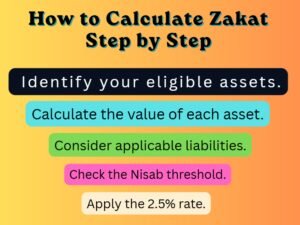
You can follow these general steps to estimate your Zakat:
Step 1: Identify your eligible assets.
List your cash, bank savings, gold, silver, business inventory, and other assets that may be subject to Zakat.
Step 2: Calculate the value of each asset.
Use current market values where appropriate, especially for gold, silver, and trade inventory.
Step 3: Consider applicable liabilities.
Certain debts and immediate financial obligations may be deductible under the rules you follow. The treatment of liabilities can vary, so they should be assessed carefully.
Step 4: Check the Nisab threshold.
Compare your qualifying wealth with the applicable Nisab value.
Step 5: Apply the 2.5% rate.
If the relevant conditions are met, calculate 2.5% of your qualifying wealth.
A Zakat calculator can help with the mathematical portion of this process.
What Is Nisab in Zakat?
Nisab is the minimum threshold of qualifying wealth that determines whether a person may be required to pay Zakat.
A person generally becomes liable for Zakat when their qualifying wealth reaches the applicable Nisab and the other relevant conditions are fulfilled.
The traditional Nisab benchmarks are based on the value of gold or silver.
| Nisab Standard | Approximate Weight |
|---|---|
| Gold Nisab | 87.48 grams |
| Silver Nisab | 612.36 grams |
These weights are commonly used reference values. The monetary value changes according to current gold and silver prices.
Gold Nisab vs. Silver Nisab
The gold and silver standards can produce significantly different monetary thresholds.
- Gold Nisab: Based on the value of approximately 87.48 grams of gold.
- Silver Nisab: Based on the value of approximately 612.36 grams of silver.
Because gold and silver have different market prices, the resulting Nisab values are not the same.
Scholars differ on which standard should be applied in certain circumstances, particularly when wealth consists of a combination of cash, precious metals, and other assets.
For this reason, it is important to follow the guidance of a qualified Islamic scholar or the religious authority you trust.
A Zakat calculator with Nisab can help you understand how your wealth compares with a selected threshold.
Which Assets Are Included in Zakat Calculation?
The assets included in a Zakat calculation depend on their nature, ownership, and the applicable Islamic rulings.
The following sections explain common categories of wealth that may be relevant when using a Zakat calculator.
1. Zakat on Cash in Hand
Cash held at home or elsewhere may be included in your Zakat calculation.
This can include money kept for personal savings, financial security, or future expenses.
To calculate Zakat on cash, determine the amount you own on your Zakat calculation date and include it with your other qualifying assets.
Example:
If you have $2,000 in cash, that amount may be included in your total qualifying wealth.
A Zakat calculator for cash and savings makes it easier to combine cash holdings with other eligible assets.
2. Zakat on Bank Savings
Money held in bank accounts is another common component of Zakatable wealth.
Depending on the applicable rules, this may include:
- Savings account balances
- Current account balances
- Money held in other bank accounts
- Eligible funds held in financial accounts
To calculate Zakat on savings, determine the relevant balance and include it in your overall calculation.
A Zakat calculator for bank savings can help estimate the amount due when your savings are combined with other qualifying assets.
3. Zakat on Gold and Silver
Gold and silver are important considerations when calculating Zakat.
People may own these metals in different forms, including jewelry, coins, and bars.
The value of eligible gold and silver is generally determined using the applicable market price and the relevant rules.
How to Calculate Zakat on Gold
To estimate the value of your gold:
- Determine the weight of the gold.
- Identify its purity, such as 24K, 22K, or 18K.
- Calculate its market value using an appropriate price.
- Include the eligible amount in your overall Zakat calculation.
The treatment of personal gold jewelry can differ among Islamic schools of thought.
Therefore, people who own jewelry should confirm which ruling applies to their circumstances.
How to Calculate Zakat on Silver
Silver is also subject to Zakat when the relevant conditions are met.
To calculate its value, determine the weight of your silver and multiply it by the applicable market price.
A Zakat calculator for gold and silver can help combine the value of these assets with cash and other qualifying wealth.
4. Zakat on Business and Trade Assets
Business owners may need to include eligible commercial assets in their Zakat calculation.
These can include goods purchased or held for resale and other qualifying business wealth.
Examples may include:
- Retail inventory
- Wholesale merchandise
- Goods held for sale
- Eligible business cash
- Certain receivables
The treatment of business assets depends on their nature and the applicable rules.
Business equipment and assets used for operations are generally treated differently from goods held for resale.
A Zakat calculator for business assets can help estimate Zakat on qualifying trade wealth, but business owners with complex accounts should seek qualified guidance.
5. Zakat on Investment Property
Property ownership can raise important questions about Zakat.
The treatment of a property depends largely on its purpose and the applicable Islamic rulings.
For example:
- A personal residence is generally treated differently from commercial inventory.
- Property purchased for resale may be subject to different rules from property held for personal use.
- Rental income and accumulated savings may require separate consideration.
A Zakat calculator for investment property can help organize relevant financial information, but it is important to distinguish between property held for personal use, rental purposes, and resale.
Do not automatically include the full market value of every property you own without checking the applicable ruling.
6. Zakat on Other Assets
Some people have additional assets that may require consideration.
These may include certain investments, eligible receivables, or other forms of qualifying wealth.
The rules can vary depending on the type of asset and how it is held.
When using a Zakat calculator for personal wealth, include only assets that are applicable under the religious guidance you follow.
How to Use Our Free Zakat Calculator Online
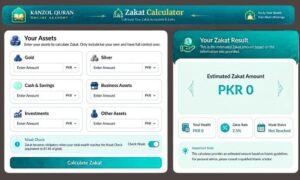
Our free Zakat Calculator online is designed to make the estimation process straightforward.
You can use it to enter different categories of wealth and view an estimated Zakat amount.
Step 1: Enter Your Cash in Hand
Enter the total amount of eligible cash you currently hold.
Step 2: Add Your Bank Savings
Enter the relevant balance of your bank savings and other qualifying account balances.
Step 3: Enter the Value of Your Gold
Add the value of your eligible gold holdings using an appropriate market valuation.
Step 4: Enter the Value of Your Silver
Add the market value of your eligible silver holdings.
Step 5: Add Business or Trade Assets
Enter the value of qualifying business inventory and other applicable trade assets.
Step 6: Include Other Eligible Assets
If you have additional qualifying assets, enter their value in the relevant fields.
Some asset categories may require separate religious guidance before they can be included.
Step 7: Select Your Currency
Choose the currency you want to use for your calculation.
Make sure that all amounts are entered in the same currency.
Step 8: Review Your Zakat Summary
The calculator displays your entered asset totals, Nisab status, and estimated Zakat amount.
Review the figures carefully to ensure that your entries are accurate.
Use the calculator below to estimate your Zakat:
Enter your eligible wealth and review the result before making your payment.
Zakat Calculation Examples
The following examples demonstrate how the 2.5% rate works.
These examples are illustrative and assume that the stated amounts qualify for Zakat and meet the applicable conditions.
Example 1: Zakat on Cash and Savings
Suppose a person has:
| Asset | Amount |
|---|---|
| Cash in Hand | $2,000 |
| Bank Savings | $6,000 |
| Total Wealth | $8,000 |
If the full $8,000 qualifies for Zakat:
Zakat = $8,000 × 2.5% = $200
The estimated Zakat is $200.
Example 2: Zakat on Gold and Cash
Suppose a person has:
| Asset | Amount |
|---|---|
| Eligible Gold Value | $5,000 |
| Cash in Hand | $2,000 |
| Bank Savings | $3,000 |
| Total Wealth | $10,000 |
If the full amount qualifies:
Zakat = $10,000 × 2.5% = $250
The estimated Zakat is $250.
Example 3: Zakat on Business Assets
Suppose a business owner has:
| Asset | Amount |
|---|---|
| Eligible Business Inventory | $12,000 |
| Business Cash | $3,000 |
| Total Wealth | $15,000 |
If the full amount qualifies:
Zakat = $15,000 × 2.5% = $375
The estimated Zakat is $375.
These examples do not determine whether a person is individually liable for Zakat. The Nisab threshold, lunar-year requirement, and applicable rules must also be considered.
Why Use a Zakat Calculator?
Calculating Zakat manually can become complicated when a person owns several types of assets.
A Zakat calculator can make the process easier by organizing financial information and applying the selected calculation rate.
1. Simplifies Zakat Calculation
Instead of calculating 2.5% manually, you can enter your eligible wealth and review the estimated result.
2. Helps Organize Different Assets
A calculator allows you to enter cash, savings, gold, silver, and other relevant assets in one place.
3. Makes Financial Planning Easier
Understanding your estimated Zakat amount can help you plan for your annual payment.
4. Provides a Clear Summary
A Zakat summary helps you review your total entered assets and estimated payment.
5. Supports Multiple Currencies
A calculator that supports different currencies can be useful for people who manage their wealth in different countries.
Always confirm that the currency conversion and asset values are accurate before relying on the result.
Common Mistakes to Avoid When Calculating Zakat
A careful calculation can help reduce confusion and prevent common errors.
Using Outdated Gold and Silver Prices
Gold and silver prices change over time.
Using outdated prices can affect the estimated value of your assets and the Nisab threshold.
Use current market prices when calculating the value of precious metals.
Confusing Income With Savings
Zakat is not simply a fixed percentage of every salary payment.
The calculation focuses on qualifying wealth and the relevant conditions.
Money that has been spent and is no longer owned is treated differently from money retained as savings.
Ignoring the Nisab Requirement
The Nisab threshold is an important part of determining Zakat liability.
Do not assume that every person who owns some savings must automatically pay Zakat.
Including Every Property Automatically
Not every property is treated as Zakatable wealth in the same way.
Personal-use property, rental property, and property held for resale may have different rulings.
Forgetting the Lunar-Year Requirement
For many forms of monetary wealth, Zakat is associated with the completion of a lunar year under the applicable rules.
The relevant timing should be checked carefully.
Relying on a Calculator Without Reviewing Its Assumptions
A calculator may use a particular Nisab standard or make assumptions about eligible assets.
Review its methodology and seek qualified guidance if your situation is complex.
The Importance of Giving Zakat
Zakat is more than a financial calculation. It is an act of worship that reflects generosity, responsibility, and care for others.
Through Zakat, eligible Muslims support people who are entitled to receive assistance under Islamic teachings.
Allah says in the Quran:
وَأَقِيمُوا الصَّلَاةَ وَآتُوا الزَّكَاةَ
Translation: “And establish prayer and give Zakat.”
— Surah Al-Baqarah, 2:43
Giving Zakat with sincerity and care is an important part of fulfilling this religious obligation.
Understanding the rules, identifying eligible wealth, and calculating the amount correctly can help Muslims approach their responsibility with greater confidence.
Calculate Your Zakat With Kanzol Quran
Calculating Zakat does not have to be complicated.
The Kanzol Quran Zakat Calculator helps you organize your cash, savings, gold, silver, business assets, and other relevant wealth to estimate your Zakat.
Whether you are calculating Zakat on savings, gold, and cash, or eligible business assets, the calculator provides a convenient way to review your financial information.
Use our free Zakat Calculator online to estimate your Zakat and plan your annual payment.
Before making your payment, verify your Nisab threshold, asset eligibility, and any applicable deductions according to the Islamic guidance you follow.
May Allah accept your Zakat, bless your wealth, and make it a source of goodness for those in need. Ameen.
Frequently Asked Questions About Zakat Calculation
The commonly applied rate for qualifying monetary wealth is 2.5%.
If your qualifying savings and other relevant wealth meet the applicable Nisab and other conditions, your Zakat is generally calculated at that rate.
Add your eligible cash and bank savings to your other qualifying assets.
Check the applicable Nisab and other conditions, then calculate 2.5% of the qualifying amount.
A Zakat calculator with Nisab helps estimate your Zakat and compare your qualifying wealth with a selected Nisab threshold.
It can make the calculation easier by organizing your assets and displaying the estimated result.
For qualifying monetary wealth, the commonly applied Zakat rate is 2.5%, equivalent to one-fortieth of the eligible amount.
Other forms of Zakat, such as agricultural Zakat, have different rules.
Gold, silver, and cash may be combined when calculating qualifying wealth under the applicable rules.
However, the treatment of jewelry and the choice of Nisab standard can differ according to scholarly guidance.
Qualifying business inventory and certain other commercial assets may be subject to Zakat.
The treatment of business equipment, liabilities, and other assets depends on the relevant rules.
A personal residence is generally not treated as Zakatable wealth in the same way as commercial inventory or property held for resale.
However, the treatment of rental income, investment property, and other related assets may require separate consideration.
Yes. If the calculator supports PKR, you can enter your eligible wealth in Pakistani rupees.
Make sure that your asset values and Nisab threshold are based on appropriate current prices and the religious guidance you follow.
An online Zakat calculator can provide a useful mathematical estimate when the entered amounts and calculation assumptions are correct.
However, it cannot automatically resolve every religious question involving debts, investments, jewelry, or unusual financial circumstances.
Zakat is generally due when the relevant conditions are fulfilled, including the applicable lunar-year requirement for many forms of wealth.
Ramadan is a common time for Muslims to pay Zakat, but the timing of an individual’s obligation depends on their circumstances.